Does Anyone Get Rich on eBay? By Elizabeth Millard
July 3, 2006 8:15AM
"There are those who get rich on eBay, but there is also more smoke than fire," says Joe Kennedy, author of "The Small Business Owner's Manual." "There are a lot of people working really hard and not making much money. The kicker is that they don't really realize it."
New browsers are coming that could make or break your online sales. Read ?SSL in High-Security Browsers? to discover the latest best practices for keeping your customers and sales secure.
In its nearly 11 years of existence, the auction site eBay has come a long way from its early days as a souped-up online flea market. Thanks to its anyone-can-sell business model, and a prevailing philosophy that there's a buyer out there for anything, eBay has become the granddaddy of all auction sites. Countless people have managed to sell an item or two at a profit.
Some people have even managed to make a tidy living by selling stuff on eBay, sacrificing nights and weekends to keep their inventories moving. And some of these so-called PowerSellers do well enough to ask themselves a potentially life-changing question: Is eBay a place where I can get rich?
Some PowerSellers claim that riches can be had, but that it takes an almost-obsessive focus on how the selling is done, what's being sold, and how inventory is managed. In other words, if someone selling $1 geegaws on eBay envisions buying a private island someday, he or she had better keep dreaming. If, however, those widgets are $50,000 each, some snorkeling gear might yet lie in the future.
The PowerSellers of eBay know that what seems to be a straightforward business venture -- you sell, someone buys -- is actually a complex maze of strategies, price controls, feedback, and site policies. Playing all of these elements to one's advantage can make the stock exchange seem like a snap. Whether the payoff from eBay can make a seller rich is another question entirely.
Going Past Gold
First, a little insider information. On eBay, to realize an enormous profit, you almost always need to become a Titanium PowerSeller.
A tiered system designed to reward qualified sellers, the PowerSeller program is by invitation only, and has a number of criteria that must be maintained to keep the designation. At the lowest level, Bronze, a PowerSeller must average at least $1,000 in sales per month for three consecutive months; have an account in good standing; and get an overall feedback rating of 100, with at least 98 percent of the comments marked as positive.
Just like credit cards, the more precious the metal, the higher the status. Bronze is followed by Silver ($3,000 in sales per month) and Gold ($10,000). The PowerSeller program makes a big jump at Platinum ($25,000), but that's a minor hop compared to the gulf between Platinum and Titanium. That top-tier designation requires $150,000 per month in sales, and sellers must maintain that level, as well as a 98 percent positive-feedback rating, to keep it. (continued...)
(Page 2 of 6)
Feedback plays an enormous role, which should come as no surprise to anyone who's ever bought something on eBay and been pestered to post positive comments. If feedback levels drop even slightly -- from 100 to 98, for example -- a seller's status is threatened. Once you lose feedback credibility on the site, it can be a hard climb back, even if 97 percent of the comments are positive.
Fortunately, a few annoyed buyers won't completely kick you to the curb, since the program calculates feedback ratings differently than the ratings visible on the member profile pages. What buyers see is a rating based on unique users, while the PowerSeller score is based on total feedback, to reflect the overall happiness of repeat buyers. Because PowerSellers depend heavily on repeat buyers, and Titanium PowerSellers in particular rely on such business, the system helps sellers maintain their status.
EBay does not release any numbers on its PowerSellers. According to Amy Joyner, author of "The eBay Millionaire," less than 4 percent of the millions of eBay merchants have earned PowerSeller status, and of these, only a tiny slice have gone Titanium. What they sell ranges from vintage Rolex watches to designer shoes to sports collectibles, Joyner notes, all the way up to Mini Cooper automobiles, jewelry, and computers.
Select Sellers
Although they are relatively few in number, Titanium PowerSellers do exist, and several started their businesses with modest means.
A prime example is David Wirtenberg, a 28-year-old entrepreneur who runs Outrageous Auctions, which has its own retail arm but also sells enough merchandise on eBay to garner the Titanium tag. Wirtenberg got involved in online auctions in 2003, while unemployed. His father-in-law suggested selling jewelry on eBay, and after only three months, Wirtenberg had lined up a supplier, hit the Titanium level, and began hiring employees.
Such success, seemingly overnight, wasn't without effort or the need for a cash infusion to get started, Wirtenberg says: "To ramp up, you need money, that's just the way it is." Although Wirtenberg shares no details on how he acquired his start-up funds, he does say that once inventory is in place, it's all about buckling down and working hard. He also acknowledges that it doesn't hurt to be selling expensive rings instead of 99-cent CDs.
However, selling expensive wares can be a Catch-22. The path to Titanium status might be shorter, with just a handful of items needing to be sold to hit $150,000 per month, but it's also much harder to convince people to shell out tens of thousands of dollars to an online seller. Even with the ubiquity of online retailers and the success of higher-priced items on home shopping TV channels, many prospective buyers still hesitate when it comes to punching in their credit card number or PayPal account details. (continued...)
(Page 3 of 6)
"If someone is scared to buy a $300 iPod online, think of how nervous they are to buy a $5,000 ring," says Wirtenberg. "That's why PowerSellers have to focus so strongly on conveying trust, and distinguishing themselves as individual sellers. People aren't buying from eBay, they're buying from us. And that's an important distinction."
Most companies are adamant that they provide stellar customer service even if they don't, but when PowerSellers talk about customer care, they mean it -- and the proof is in the ratings. Outrageous Auctions maintains a rating of 100 percent positive feedback, and Wirtenberg emphasizes that earning so many smiley-face icons takes a great deal of work.
"Whatever our customers want, we do," he says. "We follow up on everything. We understand this is a big purchase for most of them, but we know that once we have a new customer, that's our customer for life. So we put a lot of emphasis on giving them the greatest retail experience possible."
Powerful Evidence
Further demonstrating that PowerSellers seem to sprout from humble beginnings, another Titanium member, Mike Shelton, was working at a golf pro shop when he started selling on eBay to help his employer liquidate some extra inventory.
Before long, Shelton had taken on a partner and started a company, Designer Athletic, that sells retailer overstocks. Although the company has several employees to handle sales, Shelton still creates hundreds of auctions every day, and even fills some of the orders himself. In 2004, less than a year after the company was founded, it had revenues of $5 million.
Another Titanium PowerSeller, John Stack, started selling on eBay as he got ready to close his family's restaurant-equipment business in 1999. After putting 50 coffeemakers on the site, and getting far more money for them than he thought he would, Stack became an "eBayer," and began listing more and more items. He reached $10 million in revenues within five years.
Although all of these PowerSellers might hawk different types of items, and at different price ranges, they tend to have certain attributes in common -- for starters, very few start out on eBay looking to become Titanium sellers. Rather, they seem to have a knack for selling and find that eBay is an effective channel for their talents. They're willing to put in the inordinate amount of time it takes to answer e-mails, ship packages, create listings, and find new inventory sources. (continued...)
(Page 4 of 6)
"There are many eBay hucksters around, people who promise that amateurs can earn quick and easy riches by selling on the Web site," Joyner writes. "But these top-level PowerSellers are frank about the hard work that is required to truly build a multimillion-dollar business."
Making Bank
The lure of Titanium status might be compelling, but some eBay sellers believe that it's tough enough to make a decent living on the site, much less become a millionaire. "Can you get rich on eBay? In a word, no," says Terry Gibbs, author of "The Auction Revolution." Gibbs does a weekly eBay educational segment for Clear Channel radio, and was one of the first large consignment operators to do business on the site.
The problem, he notes, is the "volume trap." The only way for a seller to increase income is to list more items, but that means finding more wholesalers, amping up an inventory system, and spending more time packing and shipping.
"If you are selling new items, the competition ends up raising the prices you must pay for your stock," Gibbs says. "Also, once you establish yourself, others will undercut your prices in order to take your sales, driving your profits per auction down."
People selling used items also get slammed by the same market forces, he adds. If you are selling an antique or collectible, you can look up pricing information on eBay first, and then sell the items yourself for slightly less, rather than go through a PowerSeller.
There are sellers who can hack it, Gibbs says, but he believes they're few and far between.
"The majority of the larger eBay sellers sacrifice lifestyle for volume," he says. "The smaller sellers chase this volume because they think it's the only way and ignore the consequences."
But Gibbs does know some sellers who have managed to escape the list-and-ship treadmill by hiring employees. This will ease time restraints and leave the seller more time to investigate alternate sources of inventory, but it comes with its own difficulties. For one thing, paying extra workers eats into profits; for another, having an extra set of hands doesn't automatically mean that inventory issues will be solved. (continued...)
(Page 5 of 6)
"The sellers who can do it are masters at sourcing products," Gibbs says. "That's where the profit really comes from. The eBay auctions are just a sales channel. If eBay wasn't there, these people would still be successful."
Tricky Business
For those eBay sellers who don't trade in expensive goods, the path to riches is likely to be much tougher, maybe even impassable. Hitting the jackpot depends not only on the amount of time seller put into the effort -- which, by many estimates, is "every possible second" -- but also on how they manage inventory and budgets.
To succeed in making a living selling on eBay, one has to go into it with eyes wide open, says Joe Kennedy, author of "The Small Business Owner's Manual." Kennedy advises a number of eBay sellers and sells a modest number of items himself.
"There are those who get rich on eBay, but there is also more smoke than fire," he says. "What I've found is that if you're a buyer, you can get incredible deals, but the flip side of that is the sellers have to sacrifice to offer them. There are a lot of people working really hard and not making much money. The kicker is that they don't really realize it."
Although it seems odd that sellers would be unaware of losing money, Kennedy notes that it happens frequently, because of the way the system is set up. Sellers might turn over a healthy amount of inventory, get it shipped quickly, and have the money in their accounts promptly, but the level of detailed bookkeeping necessary can give sellers a skewed view of their operations. They might look like they're headed toward riches on paper, but in reality, it could be the road to the poorhouse instead.
"Some work like dogs, and they figure that because they're working so hard, they're doing really well," Kennedy says. "But the fee structures are complex with credit card services and auction management, and it could be that they're losing just a little bit of money on every deal. It happens far more often than most people think. EBay buyers wonder how people can sell things for so cheap, and the answer is: They can't."
To pocket a nice amount of revenue, a PowerSeller has to have access to good products at good prices. While that seems obvious, it's certainly not easy, says Kennedy. (continued...)
(Page 6 of 6)
"So many people are scavenging and undercutting each other," he says. "The sellers are a strong community, and support each other, but one thing they won't tell each other is where they get their products."
Going, Going, Gone
If a seller does manage to find a solid supplier, that's when the real work begins. To turn a profit, a seller has to be shipping every day, and often must broaden the product range to capture more buyers.
So, with the right pieces in place, it is possible to get wealthy, even if it means kissing most of your free time goodbye. But look at it this way: If you never take a vacation or have time to go out to dinner or even see a movie, then that just means more money in the bank, right?
"When you offer more products and do that much shipping, it eats up your time," says Kennedy. "To be Titanium, you have to be selling a lot, adding products, changing prices, tweaking your listings. On top of that, you have to figure out where the money is going in an extremely complex system. There are only so many hours in the day, and you'll end up using all of them on eBay."
Jim Griffith, who holds the title of dean of education at eBay, agrees that when it comes to success, eBay tends to foster an environment of "survival of the most dedicated."
"When you have the initial flush of success, it can be overwhelming, and you have to stay nimble," he says. "It's like any marketplace, where you have to constantly be on the lookout for more efficient ways of doing business."
Although eBay doesn't release figures on its PowerSellers, Griffith did note that the number of PowerSellers is climbing, and that those sellers are learning to be more flexible and strategic as the site evolves.
"The glib answer is that it's easy to get rich on eBay if you have the money to do it," he says. "But for those who don't start with capital, it really is possible to reap some serious financial benefits."
martedì, luglio 04, 2006


sabato, giugno 10, 2006
ALLOFMP3.com
Sito particolarmente interessante dove scaricare legalmente mp3, ogg, wmv e altri formati lossy che adesso mi sfuggono.
Is it legal to download music from AllOFMP3.com?
The availability over the Internet of the ALLOFMP3.com materials is authorized by the license # LS-3?-05-03 of the Russian Multimedia and Internet Society (ROMS) and license # 006/3M-05 of the Rightholders Federation for Collective Copyright Management of Works Used Interactively (FAIR). In accordance to the licenses' terms MediaServices pays license fees for all materials downloaded from the site subject to the Law of the Russian Federation "On Copyright and Related Rights". All these materials are solely for personal use. Any further distribution, resale or broadcasting are prohibited.
The works available from ALLOFMP3.com are protected by the Law of the Russian Federation "On Copyright and Related Rights" and are for personal use of a buyer. Commercial use of such material is prohibited. Recording, copying, distribution on any media is possible only upon special consent of a Rightholder.
The user bears sole responsibility for any use and distribution of all materials received from AllOFMP3.com. This responsibility is dependent on the national legislation in each user's country of residence. The Administration of AllOFMP3.com does not possess information on the laws of each particular country and is not responsible for the actions of foreign users.
domenica, aprile 02, 2006

Una giornata al mare
 Meravigliosa giornata di sole e mare. La prima giornata di primavera al mare con la bimba quest'anno.
Impossibile non immortalare la Sella del Diavolo in tutto il suo splendore, sotto il sole di mezzogiorno a Cagliari.

April's Fool Day - Pesce d'Aprile
Ho voluto pubblicare un paio di articoli divertenti apparsi sulle pagine html che consulto costantemente. La notizia che mi ha fatto trasalire di più, poiché ero soprapensiero, è quella del kernel Linux in Windows Vista. Ci sono approdato leggendo il blog di un ex-dipendente Microsoft che è appena passato in Google (tale Robert Scoble Announcement, I?m going to Google ). Alla fine del suo articolo, annuncia candidamente "Update: did you see the Windows Vista news? Maybe I should have stayed at Microsoft!" e seguendo, appunto, il link sono arrivato a quella notizia del kernel Linux. Dopo un paio di secondi di atterrimento, leggendo di volata quelle oscure parole inglesi, ho capito che si trattava di un classico pesce d'aprile.
Esattamente come quello tentato in anticipo da N.S. giovedì pomeriggio in ufficio.
Bah...!
Sono un po' stanchino, la mamma non è ancora rientrata dall'addormentare la bimba ed io, come un pirla, non mi sono messo a vedere nemmeno un filmino. Mi sono accontentato di vedere Scrubs e basta.
Bah...! Basta scrivere per oggi.
Esattamente come quello tentato in anticipo da N.S. giovedì pomeriggio in ufficio.
Bah...!
Sono un po' stanchino, la mamma non è ancora rientrata dall'addormentare la bimba ed io, come un pirla, non mi sono messo a vedere nemmeno un filmino. Mi sono accontentato di vedere Scrubs e basta.
Bah...! Basta scrivere per oggi.
How to Win a Street Fight - WikiHow


The How-To Manual That Anyone Can Write or Edit
How to Win a Street Fight

Although the best way to 'win' a street fight is to avoid one, we are not always so lucky. There are many fighting techniques around to deal with combat, should it come down to that, but taking a martial art or self-defense class doesn't guarantee your safety. This is a guide to help you in making simple, deliberate actions to end the fight.
Steps
- Try walking or talking your way out of it. Most people are only trying to establish a "tough," respected image. Nevertheless, don't "tip your hand" by letting them know your intentions in any given situation. If you can resolve a dispute without having to trade blows, do so, but don't invite a fight by looking weak, backing away too quickly, or showing too much fear or anxiety. Don't let your ego (or lack of it) become a liability to your safety.
- Know when and how to run:
- If you are outmatched or outnumbered, or just not willing to fight, then run with the first opportunity.
- Try to run towards public, well-lit areas where there will be others.
- Be aware of your environment:
- Aside from various objects that can be used as weapons and traps, knowing where to run is very important--especially when you're outnumbered.
- Use all of your senses fully. Don't just look around directly--use shadows and reflections to your advantage. Keep your ears open as well.
- Err on the side of caution, by assuming the following:
- Your opponent is a better fighter, and has back-up.
- He/she has a blunt or edged weapon, such as brass knuckles or a knife.
- You will be hit. This is less of an assumption than a certainty, if you keep fighting after being hurt, you are less likely to submit.
- Keep your guard up. Even if it's only by extending your hands in a 'stay-back' type pose, it places something between you and your opponent. Nevertheless, do not allow your hands to become too far extended to harm either balance or striking ability. Also, do not allow the opponent to grab your hands or arms (break the grip with a quick rotation in the "weak" direction toward the opponent's thumbs) as either your balance or your orientation (by the cross-arm pull) may be easily compromised.
- Stay roughly two arms' length (about five and a half to six feet) from your opponent, allowing the distance to shorten only to attack or counter an opponent.
- Try to stay on an opponent's 'outside' (i.e. towards the side, rather than directly in front). Remember that they can be an obstacle to themselves.
- If fighting more than one opponent, move in such a way as to keep them in each other's way. Don't stay between them, and if possible limit the directions they can attack from.
- Attempt to evade an attack completely. Simply blocking an opponent with your arms or legs leaves the rest of your body in the way.
- Stay on your feet. Going to ground is very dangerous to the untrained fighter, especially if they have weapons, back-up or ground-fighting experience. Conversely, it is to your advantage to have your opponent(s) on the ground. Watch your opponent's balance for over-extension or other instabilities, and then quickly put him on the ground.
- Equally, minimize grappling time, as such opens windows of opportunities and exposure to other fighters. As arresting attacks tend to grappling, use leverage to put the aggressor on the ground.
- Balance is key. Keep your balance, and attack your opponents' balance when you can. Limit the opponent's movement of the feet and/or legs with your own feet and legs, move the opponent off balance, and protect your own balance by breaking the opponent's grip and by striking at the face (for instant disorientation during the fall).
- Attack any open, vulnerable spot without exposing too much of yourself. Damage to the face, temples, throat, kidneys, solar plexus, etc. may eventually incapacitate your opponent. Strategic strikes to the groin, the back of the head (temporarily disrupts vision), the knees, and the eyes are particularly effective without requiring much force, effort, or time. Attack the eyes with sand, dirt, mace, or other sprays. Fight, pursuit, and flight are all equally ineffective without sight (even temporarily).
- Phone the police or alert some other authority, even if you do escape. If you're in a club, and someone is up for a fight, find a bouncer. The 'fighter' may not just be looking at you for a fight. Such authorities are here to protect people, and are trained in dealing with this sort of thing.
- Remember in order of priority: walk, talk, fight. Fighting is an absolute last resort.
Tips
- Keep calm. If you need to, breathe deeply. If you know how to clear your head, do so. Unwanted distractions will only make you more likely to get hurt.
- If someone else is better trained at dealing with this situation, leave it to them. Don't try to interfere, as you may end up causing more trouble. Follow any reasonable commands they give you.
- If attempting to escape in the 'middle' of a confrontation, you should ideally kick, trip, or send opponents off balance before running.
- Keep things simple. Fights in films are choreographed. Real ones aren't.
- Attacks from behind are difficult to see and avoid, and in a real fight, it is not 'cowardly' to strike from behind. Watch your back, and attack that of your opponent(s).
- Many of the weakest spots are down the 'center-line' of the body (i.e. down an imaginary line drawn from forehead to groin). Take advantage of this in offense and defense, and try to face an opponent almost side-on, as it makes your 'center-line' more difficult to attack.
- Be aware of the 'zones' of fighting (from the most distant); weapons, feet, hands, knees, elbows, grappling.
- Think before you act. Only employ an attack, grab, or other offensive technique when you are almost certain it will work the way you want it to.
Warnings
- High kicks are rarely a good idea, especially if your opponent is untangled. Keep them below the waist for best effect.
- Fighting can cause injury or death, and land you in jail. Conversely, ineffective fighting can cost your life at the end of the day.
- This guide is presented as an assistant for a difficult situation, and is not intended as a substitute for actual martial arts training. If you are concerned with learning to defend yourself against physical violence, find a reputable self-defense class in your area. If you do not know where to begin, consider asking at your local police station.
China buys Google | The Register
China buys Google
Mu Shu Porked
Published Saturday 1st April 2006 04:24 GMT
Exclusive The People's Republic of China has acquired a controlling stake in the United States' fastest growing technology company, Google.
Google announced the transfer of 140m shares of Class B stock to a new entity owned by the Chinese Ministry of Information in typically forthright style. The news was disclosed in a Captcha graphic on its Google Canteen Menu weblog; investors had to click a hidden link to see the announcement, and then decode a stenographically-hidden message watermarked into the JPG file. Once decrypted, the message read:
gee it's raining here in mountain view and my cats hungry so we thought we'd better update you on our corporate finances. we've sold out to china. have a great weekend boo-yah!! lol
No other details were forthcoming.
The deal raises urgent national security questions, a six month investigation by The Register's Silicon Valley staff can reveal.
Amongst the assets acquired by the Chinese government is NASA's Ames Research Center. Google announced a partnership with Ames last year, and, as it turns out, the move laid the groundwork for the takeover by the PRC. The Chinese will gain control of the world's largest wind tunnels - devices that when opened up could be used to push the smell of Mu Shu Pork across much of Silicon Valley, or conversely be used to spread avian bird flu, or mind-altering substances.
Ministry of Information officials were conducting examinations at the Ames facility today, and requested rush hour traffic on the adjacent Highway 101 be re-routed. Caltrans officials agreed to the request.
President Bush uses Ames as his landing pad for Northern California visits and is expected to do so under the Chinese ownership.
"The Chinese make the blankets, headphones, chopsticks, stereos and tires on Air Force One," said White House spokesman, Scott McLellan. "I don't see why they can't land the damn thing too."
How we didn't break the news
It was a picture taken by a Register reader from inside the Chinese Propaganda Ministry six months ago that prompted our investigation. The shot appeared to show Government artists harnessing the youthful charisma of Google's founders for a productivity campaign.
Only when we saw further evidence of the artwork did the penny drop.

[ Click to unblur]
Google's founders have reciprocated the gesture, and as this photograph ahead of today's official announcement shows, they are making extraordinary efforts to have the company's new management feel at home.

[ Click to see excellent Plastic Sergey-ry ]
The cosmetic surgeon who supplied the evidence confirmed the operations had been successful.
Our investigations suggest that Google has been working on behalf of the People's Republic for many years. Its activities include collecting data on US citizens - Google recently fought a US government request to hand over its data in the courts - and owning key parts of the nation's communications infrastructure.
In fact, security analysts who've seen the evidence suggest that Google is little more than a PRC front organization.
Behind the colored balls
The roots of the Google/China conspiracy can be traced back to Sergey Brin's father Michael Brin. The Russian-born mathematician grew disaffected with the USSR's brand of communism and joined an elite task force of communist China sympathizers operating out of Moscow. Members of the organization - Chinuks - would pass messages to each other inside of plastic, colored balls. Their shared mission was to revive a purer Maoist form of Communism in China, and they planned to aid the country through technology advances.
Sergey grew up learning the ways of the Chinuks and from an early age committed himself to bringing Michael's dreams to fruition.
A team of Chinuks worked with Sergey for fifteen years to create a search algorithm powerful enough to attract hundreds of millions of people to their product. The Chinuks and Brin managed to convince Stanford, and later German Andy Bechtolsheim, to fund their efforts. The group also handpicked Larry Page as an American patsy to distract attention away from their dark ambitions, and then cemented the masquerade by hiring a retired teacher, Eric Schmidt.
Until early this week, Schmidt had no idea he was fronting a data gathering operation for a foreign power, and had told friends and family he was supervising an after hours therapy center for local children suffering from Asperger's Syndrome.
Billions of dollars and a steady supply of crayons have kept Page and Schmidt quiet.
In peril: Our Nation's Youth
The Register's investigation has turned up evidence that Google has been feeding data on US citizens to China for years. But more disturbingly, psychological experts and economists are concerned that Google's enthusiasm for addictive and distracting technologies such as "Web 2.0" will fatally sap US productivity for years to come.
"It's the Opium Wars in reverse," said one former national security adviser, speaking under condition of anonymity.
The deal also compromises the United States' lead in the strategically vital areas of blogging software, AJAX-powered PowerPoint clones, and dysfunctional video services of cats falling out of trees.
Glimpses of what the new Google website looks like can be seen here.
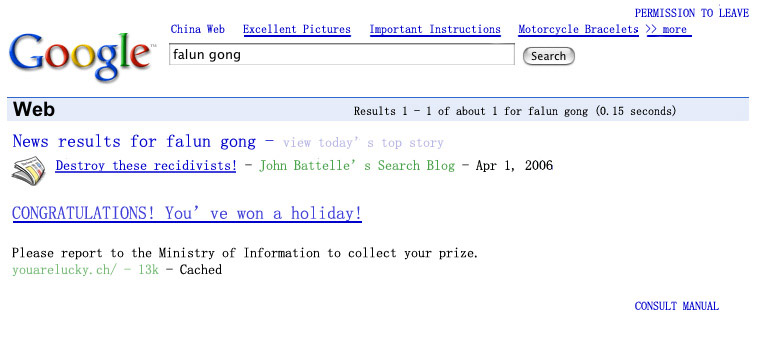
[ Click to see Great Leap Forward in Search Quality ]
Even Google's Maps has not escaped the PRC-initiated makeover. International policy relations experts tonight expressed concern about some of the changes:

[ Click to see Ominous Warning ]
Coincidentally, today, the Chinese news service Xinhua reported that dot com era publisher John Battelle has been appointed to the Ministry of Information's Propaganda Unit. ®
[Thanks to Splinter Products for the shots from inside the Chinese Propanda Ministry, and inside the Sergeyry.]
Microsoft Patents Ones, Zeroes | The Onion - America's Finest News Source
Microsoft Patents Ones, Zeroes | The Onion - America's Finest News Source: "Microsoft Patents Ones, Zeroes
March 25, 1998 | Issue 33?11
REDMOND, WA?In what CEO Bill Gates called 'an unfortunate but necessary step to protect our intellectual property from theft and exploitation by competitors,' the Microsoft Corporation patented the numbers one and zero Monday.
Enlarge ImageMicrosoft Patents 01
At a press conference beamed live to Microsoft shareholders around the globe, Bill Gates announces the company's patenting of the binary system.
With the patent, Microsoft's rivals are prohibited from manufacturing or selling products containing zeroes and ones?the mathematical building blocks of all computer languages and programs?unless a royalty fee of 10 cents per digit used is paid to the software giant.
'Microsoft has been using the binary system of ones and zeroes ever since its inception in 1975,' Gates told reporters. 'For years, in the interest of the overall health of the computer industry, we permitted the free and unfettered use of our proprietary numeric systems. However, changing marketplace conditions and the increasingly predatory practices of certain competitors now leave us with no choice but to seek compensation for the use of our numerals.'
A number of major Silicon Valley players, including Apple Computer, Netscape and Sun Microsystems, said they will challenge the Microsoft patent as monopolistic and anti-competitive, claiming that the 10-cent-per-digit licensing fee would bankrupt them instantly.
'While, technically, Java is a complex system of algorithms used to create a platform-independent programming environment, it is, at its core, just a string of trillions of ones and zeroes,' said Sun Microsystems CEO Scott McNealy, whose company created the Java programming environment used in many Internet applications. 'The licensing fees we'd have to pay Microsoft every day would be approximately 327,000 times the total net worth of this compa"
March 25, 1998 | Issue 33?11
REDMOND, WA?In what CEO Bill Gates called 'an unfortunate but necessary step to protect our intellectual property from theft and exploitation by competitors,' the Microsoft Corporation patented the numbers one and zero Monday.
Enlarge ImageMicrosoft Patents 01
At a press conference beamed live to Microsoft shareholders around the globe, Bill Gates announces the company's patenting of the binary system.
With the patent, Microsoft's rivals are prohibited from manufacturing or selling products containing zeroes and ones?the mathematical building blocks of all computer languages and programs?unless a royalty fee of 10 cents per digit used is paid to the software giant.
'Microsoft has been using the binary system of ones and zeroes ever since its inception in 1975,' Gates told reporters. 'For years, in the interest of the overall health of the computer industry, we permitted the free and unfettered use of our proprietary numeric systems. However, changing marketplace conditions and the increasingly predatory practices of certain competitors now leave us with no choice but to seek compensation for the use of our numerals.'
A number of major Silicon Valley players, including Apple Computer, Netscape and Sun Microsystems, said they will challenge the Microsoft patent as monopolistic and anti-competitive, claiming that the 10-cent-per-digit licensing fee would bankrupt them instantly.
'While, technically, Java is a complex system of algorithms used to create a platform-independent programming environment, it is, at its core, just a string of trillions of ones and zeroes,' said Sun Microsystems CEO Scott McNealy, whose company created the Java programming environment used in many Internet applications. 'The licensing fees we'd have to pay Microsoft every day would be approximately 327,000 times the total net worth of this compa"
Microsoft Buys OpenOffice.org!
OpenOffice.org: Home: "Microsoft Buys OpenOffice.org!"
For an undisclosed sum reputed to be in the billions, Microsoft's Bill Gates has personally bought the leading open-source desktop project. Saying he 'was sick and tired of open-source eating away at his profits,' the world's richest man decided to put an end to the nuisance and simply buy OpenOffice.org. It will form part of a growing list of Microsoft acquisitions, including several erstwhile competitors, a considerable number of prominent politicians, and a few small governments.
The initially stunned OpenOffice.org community--a happy-go-lucky international band numbering in the hundreds of thousands--later turned to champagne to celebrate their newfound wealth. 'Bless Bill!' one happy Torontonian exclaimed, bubbly in hand. 'With all this money, I can beat Mark's time in orbit!'
Gates has assured all current OpenOffice.org users that their future migration path to Microsoft Office is guaranteed thanks to OpenOffice.org's faultless support of MS Office files formats. Users can further rest assured that the full functionality currently provided by OpenOffice.org 2.0 will be available in MS-Office 2020 - or possibly 2030.
* Full Press Release"
For an undisclosed sum reputed to be in the billions, Microsoft's Bill Gates has personally bought the leading open-source desktop project. Saying he 'was sick and tired of open-source eating away at his profits,' the world's richest man decided to put an end to the nuisance and simply buy OpenOffice.org. It will form part of a growing list of Microsoft acquisitions, including several erstwhile competitors, a considerable number of prominent politicians, and a few small governments.
The initially stunned OpenOffice.org community--a happy-go-lucky international band numbering in the hundreds of thousands--later turned to champagne to celebrate their newfound wealth. 'Bless Bill!' one happy Torontonian exclaimed, bubbly in hand. 'With all this money, I can beat Mark's time in orbit!'
Gates has assured all current OpenOffice.org users that their future migration path to Microsoft Office is guaranteed thanks to OpenOffice.org's faultless support of MS Office files formats. Users can further rest assured that the full functionality currently provided by OpenOffice.org 2.0 will be available in MS-Office 2020 - or possibly 2030.
* Full Press Release"
sabato, aprile 01, 2006
Microsoft to release Vista with a Linux kernel
The Tech Journal » Microsoft to release Vista with a Linux kernel: "Microsoft to release Vista with a Linux kernel April 1, 2006
After years of delays and months of rewriting code the Microsoft Corporation has taken a new direction with Windows Vista. Microsoft will release Vista with a Linux kernel. At the press conference Bill Gates had this to say 'We are very excited at the new direction of Windows Vista. With help from Novell and IBM we have leveraged the Linux kernel and have built our GUI as a Window Manager on top of X.org. This brings the friendliness and usability model of our Windows operating system and married it to the stability and rock solid security of Linux.' When asked why Microsoft took this route Jim Allchin said ' For years our competitors and business partners have been telling us they want everything the Linux kernel offers. It was the right thing to do.' Allchin also had this to say 'With such great work being done in the Open Source community we also will be using OpenOffice.org as the base of our Office 12.' When asked how long the delays would be to bring these products to market Gates said 'What delays? 90% of the work is done for us and we didnt have to pay, this cuts our development costs and time to market considerably.'
Linus Torvalds took the stage and after a heartwarming embrace of Bill Gates Linus had these remarks, 'Its so wonderful that Microsoft has taken our work and used it to bring to market this incredible new OS. I am ecstatic of these changes'
It has been confirmed that Linus will start a new job at Microsoft as the President of Platform Strategies. When asked of his new job at Microsoft Linus said 'OSDL wasnt doing anything to help Linux along, all they did was siphon money off of our key members. Im very excited at the direction Microsoft plans to take Linux and finally feel Im in the presence of people that care.'
The new OS will be available under Microsofts"
After years of delays and months of rewriting code the Microsoft Corporation has taken a new direction with Windows Vista. Microsoft will release Vista with a Linux kernel. At the press conference Bill Gates had this to say 'We are very excited at the new direction of Windows Vista. With help from Novell and IBM we have leveraged the Linux kernel and have built our GUI as a Window Manager on top of X.org. This brings the friendliness and usability model of our Windows operating system and married it to the stability and rock solid security of Linux.' When asked why Microsoft took this route Jim Allchin said ' For years our competitors and business partners have been telling us they want everything the Linux kernel offers. It was the right thing to do.' Allchin also had this to say 'With such great work being done in the Open Source community we also will be using OpenOffice.org as the base of our Office 12.' When asked how long the delays would be to bring these products to market Gates said 'What delays? 90% of the work is done for us and we didnt have to pay, this cuts our development costs and time to market considerably.'
Linus Torvalds took the stage and after a heartwarming embrace of Bill Gates Linus had these remarks, 'Its so wonderful that Microsoft has taken our work and used it to bring to market this incredible new OS. I am ecstatic of these changes'
It has been confirmed that Linus will start a new job at Microsoft as the President of Platform Strategies. When asked of his new job at Microsoft Linus said 'OSDL wasnt doing anything to help Linux along, all they did was siphon money off of our key members. Im very excited at the direction Microsoft plans to take Linux and finally feel Im in the presence of people that care.'
The new OS will be available under Microsofts"
domenica, marzo 19, 2006
Zoom sul prodotto
Questo è il telefonino che mi sta' facendo impazzire in questi giorni.
Il mio Siemens S55 ha fatto un volo di troppo dalle mie mani e, cadendo a terra, ha fracassato il tasto "3".
Ora sono tremendamente indeciso sul telefonino nuovo da prendere. Mi sembro orientato a prendere di nuovo un Motorola, non mi sento ancora molto pronto a passare a Nokia...
Per quanto il Nokia 7210 con quei tasti disposti in maniera così inusuale mi ispiri qualcosa.
Mi odio...
Ci metto 5 secondi per decidere se comprarmi una penna e faccio la tragedia greca quando si tratta di un telefonino: in effetti non è che l'effetto patrimoniale-economico sia esattamente comparabile... Però, Sant'Iddio, potrei avere anche le idee un po' più chiare.
Bah...
Me ne vado a letto ché sono stanco morto, anche se ho dormito tre ore (3) nel pomeriggio. Domani pranzo con i suoceri... Non sarà uno scherzo!!!
Il mio Siemens S55 ha fatto un volo di troppo dalle mie mani e, cadendo a terra, ha fracassato il tasto "3".
Ora sono tremendamente indeciso sul telefonino nuovo da prendere. Mi sembro orientato a prendere di nuovo un Motorola, non mi sento ancora molto pronto a passare a Nokia...
Per quanto il Nokia 7210 con quei tasti disposti in maniera così inusuale mi ispiri qualcosa.
Mi odio...
Ci metto 5 secondi per decidere se comprarmi una penna e faccio la tragedia greca quando si tratta di un telefonino: in effetti non è che l'effetto patrimoniale-economico sia esattamente comparabile... Però, Sant'Iddio, potrei avere anche le idee un po' più chiare.
Bah...
Me ne vado a letto ché sono stanco morto, anche se ho dormito tre ore (3) nel pomeriggio. Domani pranzo con i suoceri... Non sarà uno scherzo!!!
martedì, dicembre 13, 2005
Anatomy of a Fountain Pen III: Sheaffer?s Snorkel

(This article first appeared on Richard's site.)
The Struggle to Survive: In 1952, Sheaffer introduced the most complicated fountain pen ever designed. This pen, the famous Snorkel, was designed to compete with the burgeoning popularity of ballpoint pens by virtue of its simple, convenient filling system that eliminated the mess commonly associated witih fountain pens. To fill the Snorkel, the user extends a small tube that is normally hidden within the feed; only the Snorkel tube is immersed in the ink, and there is no need to wipe off excess ink after filling. For about a decade, the Snorkel did compete successfully, with a range of models culminating in 1959?s PFM, the Pen For Men. This article illustrates a pen similar to a Sentinel, with Sheaffer?s conical Triumph nib; the company also produced Snorkels with the traditional open nib. The illustrations depict the pen with its proportions altered for artistic purposes.
?Monkey Motion?: To make the Snorkel?s filling system simple for the user meant that the pen would have to be complicated internally. The first figure shows the pen with various parts cut away to reveal the inner workings. You can see immediately that there are a large number of parts:
The Snorkel uses the Touchdown filling system that Sheaffer introduced in 1948, but in the Snorkel it is necessary to move the entire filling system within the pen. This movement is accomplished by redesigning the section that it becomes only a small bit of hard rubber that secures the sac and the Snorkel tube. The sac protector is a tight slip fit over the section, so that the assembly becomes a moderately strong ?cartridge? that can slide back and forth in grooves on the inside of the gripping section, which has replaced the original section to provide a finger hold.
The Snorkel tube is fitted through a small hole in the hard rubber section; it passes through the point holder gasket and extends to the end of a hole that has been drilled through the feed to accommodate it. The Snorkel tube contains a secondary feed, in the form of a slender strip of hard rubber with an ink channel. There are small slots near the end of the tube; these slots allow ink to ?leak? from the inside of the tube to the outside. Once outside the Snorkel tube, the ink finds that there is also a slit cut in the main feed, and capillary action draws the ink through that slit to fill the comb fins and deliver the ink to the nib in the same way as with an ordinary feed and nib.
The back end of the coupling ring screws into the gripping section to secure the point holder gasket in place. The feed slips into the coupling ring, and the nib screws onto the front end of the coupling ring to secure the feed in place.
The sac protector is threaded for part of its length. At the front end of the threaded portion is a ring into which one end of the spring fits; the other end of the spring presses against a ledge on the interior of the barrel.The Touchdown tube is threaded to match the sac protector; and the blind cap, unlike the blind cap in the ordinary Touchdown system, is not threaded.
The interior of the pen is sealed airtight by the point holder gasket, the O-ring, the threaded joint between the barrel and the gripping section, and a gasket that seals the screw securing the Touchdown tube to the blind cap. Air can enter only through a dimpled groove in the Touchdown tube near the blind cap and through a hole in the Touchdown tube near the tube?s threaded portion. The dimpled groove is open at the beginning of the Touchdown tube?s travel as it is extended from the pen, and the hole is open when it passes the O-ring as the Touchdown tube reaches its full extension. If any of the four sealing points leaks, the pen will not fill properly.
How It Works: As you can see, the spring tries to force the sac protector (and the rest of the ?cartridge?) forward, extending the Snorkel tube. The blind cap and Touchdown tube prevent this. The following figure shows step 1 of the filling process. The user unscrews the blind cap, releasing the ?cartridge? so that the spring can slide it forward.
Next, the user extends the Touchdown tube. A partial vacuum builds up, but the sac protector keeps the sac from distending. As the Touchdown tube reaches the end of its outward travel, air enters the barrel through the hole near the threaded end of the tube.
The user immerses the tip of the Snorkel tube in the ink and then presses quickly down on the blind cap. This restores the Touchdown tube to its rest position, compressing air as the tube travels. The compressed air squeezes the sac. The following illustration shows the pen at the instant just before the pressure is released by the dimpled groove when the Touchdown tube reaches the end of its travel; note the squeezed sac.
When the Touchdown tube reaches the end of its travel, pressure is released. As the sac resumes its normal shape, external air pressure forces ink into the sac.
Last, the user screws down the blind cap again. The threads on the Touchdown tube engage the threads on the sac protector, drawing the ?cartridge? backward against the spring. The Snorkel tube disappears into the section, and the user returns to writing.
Is It Working Right? To test a Snorkel, fill it with water. Aim the filled pen in some harmless direction. Extend the Touchdown tube and then depress it quickly. If all the seals are working right, the pen will shoot a stream of water that can travel about six feet (2 m).
domenica, dicembre 04, 2005


Iscriviti a:
Commenti (Atom)
